Organized Retail Theft Hitting Your Store in Groups? How Guards Disrupt It
Quick Answer: Organized retail theft crews work in coordinated roles, casing your store, timing shift changes, and moving fast in a group so no single employee can react. Trained guards disrupt that pattern by holding visible positions at entrances, exits, and high-value zones, reading pre-incident behavior before a grab starts, and using presence rather than confrontation to make your store the harder target a crew skips.
You notice it before you can name it. Three or four people come through the door within a minute of each other, split off down different aisles, and none of them are really shopping. One drifts toward the high-value case. Another lingers near the exit with a phone up. A staff member asks if anyone needs help and gets a flat "just looking." A few minutes later, an arm sweeps a shelf, the group moves as one, and they are out the door before your associate has finished turning around.
That is not a run of bad luck, and it is not the shoplifter you dealt with a decade ago. It is a coordinated crew, and the whole reason it works is that a group moving with a plan overwhelms a floor staff that is trying to sell, restock, and run registers at the same time. Organized retail theft has grown into a structured operation, and stopping it takes something built to disrupt a pattern rather than react to one incident. Here is how these groups actually operate, and how trained guards break the pattern they depend on.
How a Coordinated Crew Actually Works Your Store
The thing to understand first is that a crew is not a person who decided to steal on impulse. It is a small operation with defined roles, and the people on your floor are only the visible layer of something larger.
The roles inside a crew
Organized retail theft involves coordinated groups where each member has a specific role. Some steal merchandise, while others collect, transport, and resell stolen goods through various channels. The individual inside your store is only one part of a larger criminal operation.
The reconnaissance you never see
Organized theft crews often visit stores multiple times before acting. They observe staffing levels, camera placement, store layouts, and busy periods to identify weaknesses. Careful planning allows them to execute fast, coordinated thefts with the highest chance of success.
The Tells That Separate a Crew From a Casual Shoplifter
A single opportunistic shoplifter and an organized crew do not behave the same way, and the difference is readable if someone on your floor is trained to watch for it rather than to sell.
Coordinated movement and signaling
Organized theft crews often enter together, separate immediately, communicate by phone, and assign specific roles. These coordinated movements reveal planning and are important warning signs trained security personnel can recognize early.
Repeat visits and target focus
Multiple visits to the same high-value merchandise, especially during shift changes or quieter hours, often indicate surveillance rather than shopping. Organized crews use repeated observations to confirm their plan before attempting theft.
Concealment, matching dress, and speed
Bulky clothing, matching outfits, concealment tools, and groups gathering near exits often signal planned theft. Organized crews depend on speed, surprise, and quick escape, making these behaviors valuable indicators before an incident begins.
Why Cameras and Alarms Do Not Stop a Group in Motion
Most stores that get hit already have cameras. That is exactly the problem the crew is counting on.
The issue is not visibility, it is response. A camera documents what happened, but it does not intervene, and an alarm only announces a theft that has already occurred. Organized groups move in minutes, which opens a gap between the moment something is detected and the moment anyone can act. By the time footage gets reviewed, the merchandise is gone and the same crew may already be casing your store again or hitting the next location on their list. Recorded video helps a later investigation, but it does nothing to disrupt the pattern while it is unfolding on your floor. Nothing about a lens on the ceiling changes a crew's math, because the lens introduces no risk of being stopped.
How Trained Guards Actually Disrupt a Group
A guard changes the equation by putting back the one variable a crew works hard to remove: the chance that a real person will step into the plan and break it.
Visible presence at the pressure points
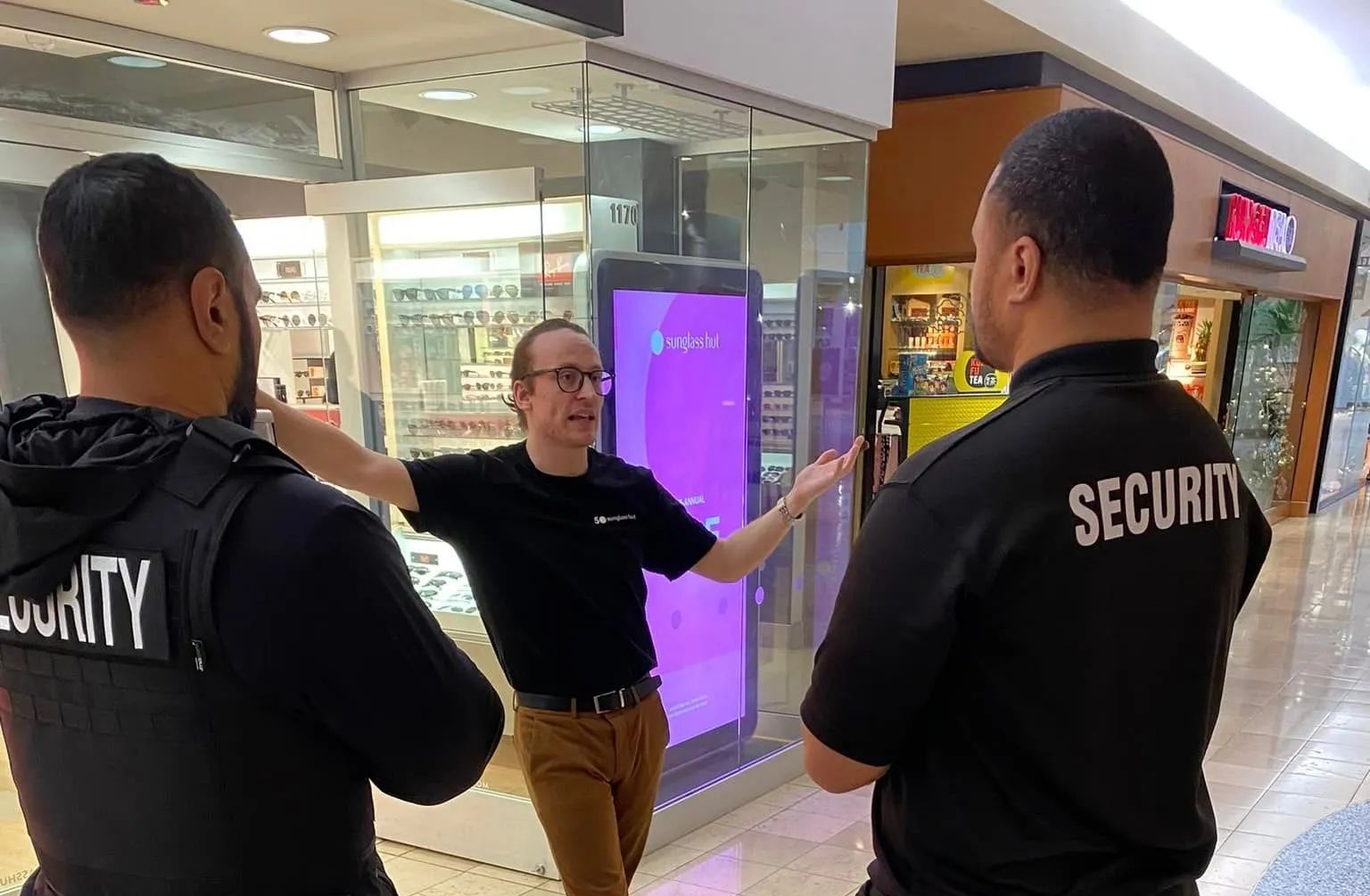
Positioning trained guards at entrances, exits, and high-value merchandise disrupts organized theft before it begins. A visible security presence removes easy escape routes, making your store a far less attractive target for coordinated retail crime.
Reading the pattern before it becomes an incident
Experienced guards identify suspicious behaviors such as repeated visits, coordinated movements, unusual loitering, and role-based actions. Early recognition allows discreet intervention before organized retail theft crews begin removing merchandise from the store.
Presence over confrontation
Professional guards prioritize prevention through visibility, communication, and de-escalation instead of physical confrontation. Their goal is to discourage theft, protect employees and customers, and coordinate with law enforcement when necessary while maintaining a safe shopping environment.
Tip: If your staff notices the same unfamiliar faces visiting a high-value section across several days without buying, treat it as reconnaissance, not coincidence. Note the days and times and share them with your guard, because that timing usually reveals exactly when a crew expects your store to be soft.
Documentation that outlasts a single shift
Because these groups hit multiple locations, a guard's real-time incident logging matters far beyond your four walls. Time-stamped notes, descriptions, and photos build a record that helps connect one visit to the next and one store to another, so a pattern that looks random from a single register becomes an obvious, trackable crew. That documentation is what turns a scattered set of incidents into something law enforcement and asset protection teams can actually act on.
Positioning Guards Where a Crew Feels the Most Risk
Where you place coverage decides how much a crew's plan gets disrupted, and it is rarely just "put someone at the front."
Entry and exit points come first, because that is where speed and escape either work or fail for the group. High-value zones near those exits need direct line of sight, since that is the merchandise a crew is most often sent to grab. The exterior matters too. Parking lots and the areas just outside your doors frequently serve as staging grounds where a group gathers, waits for accomplices, or stashes a getaway vehicle, so attention there during peak hours disrupts the plan before it ever crosses your threshold. If you run more than one location, applying the same positioning at each store keeps a crew from probing until it finds the one site you left thin.
Warning: Do not rely on a single guard planted at the front door to cover a group that has already split across your floor. A lone, fixed position is easy for a crew to work around by drawing that guard's attention while others hit a blind aisle. Coverage has to match how your store actually gets worked, or the crew simply routes around it.
Matching Coverage to How Your Store Gets Hit
The right amount of security is not a guess, it is a read of your own exposure, and it is worth walking your store the way a crew would.
Look at where your highest-value, easiest-to-resell merchandise sits and how close it is to an exit. Look at your busiest and thinnest hours, because a crew targets the gap between them. Consider whether your layout gives a group natural cover, long sightline-blocking aisles, multiple unwatched exits, or a stockroom door that opens to the outside. A small boutique with one entrance and a single high-value case has a very different exposure than a large-format store with four exits and open displays, and the coverage should reflect that. In some stores a single well-placed, visible guard resets the risk calculation entirely. In others, the honest answer is a small team positioned to cover the door, the high-value zone, and the exterior at once, so a crew cannot pull staff one direction and work another. Sizing coverage to your actual traffic, layout, and merchandise is what makes the difference between a presence a crew respects and one it plans around.
Frequently Asked Questions
How is an organized retail theft crew different from a regular shoplifter?
A shoplifter usually acts alone and impulsively. Organized retail theft crews plan ahead, assign roles, target valuable merchandise, coordinate movements, and quickly resell stolen goods. Their speed and teamwork require a proactive security strategy rather than standard loss prevention.
Can trained guards really stop a group that moves that fast?
Yes. Professional guards focus on prevention by maintaining a visible presence, recognizing suspicious behavior early, and disrupting coordinated plans before theft begins. Most organized crews avoid stores where trained security significantly increases the risk of being identified or stopped.
We already have cameras. Why would we still need guards?
Cameras record evidence after an incident but cannot physically deter theft. Trained guards respond in real time, discourage criminal activity through visible presence, assist employees, and recognize suspicious patterns before organized retail theft crews act.
What behavior should my staff flag before an incident happens?
Watch for groups splitting up after entering, people repeatedly visiting high-value displays without purchasing, suspicious phone communication, oversized clothing used for concealment, and repeated visits during quiet periods. Reporting these behaviors early helps security intervene before theft occurs.
Will a guard scare off my regular customers?
Professional security officers are trained to remain approachable, courteous, and customer-focused. Their presence reassures honest shoppers while discouraging criminal activity, helping customers feel safer without creating an intimidating atmosphere or treating every visitor with unnecessary suspicion.
How do I know how many guards my store actually needs?
The right number depends on your store's size, entrances, customer traffic, merchandise location, and theft risks. A professional security assessment identifies vulnerable areas and recommends staffing levels that provide effective coverage without unnecessary security costs.
Turning a Soft Target Into a Hard One
Organized retail theft works because a coordinated group moving with a plan beats a floor staff that is trying to do five other jobs. Every part of a crew's model, the reconnaissance, the roles, the timing, the speed, is built around the assumption that no one will step in and disrupt it. That assumption is exactly what a trained, visible guard takes away. By holding the exits and high-value zones, reading the group's behavior before a grab starts, deterring through presence instead of confrontation, and documenting the pattern across visits, guards turn your store from the soft target a crew wants into the hard one it skips. The goal is not to catch a theft on video after the fact. It is to make your store the location the group decides is not worth the risk.
Request a
retail security
assessment — If a coordinated crew has already cased your store, cameras alone leave the same gap they are counting on, and the next hit is often only a matter of timing. Elite Protection Services
places trained guards at entrances, exits, and high-value areas, identifies the pre-incident behaviors that signal organized retail theft, and disrupts incidents through visible presence and professional de-escalation rather than confrontation. With 20
years of experience serving businesses throughout Beaverton, Oregon, our team delivers security strategies tailored to how your store is actually targeted. Ask today for a walkthrough of your store's exposure and a coverage plan built around your risks.